Our Kickstarter was funded! Continue supporting the Virtual Worlds Museum™ through our Sponsor Page.

Interactive Networked Tele-Presence and Shared 3D Environment.
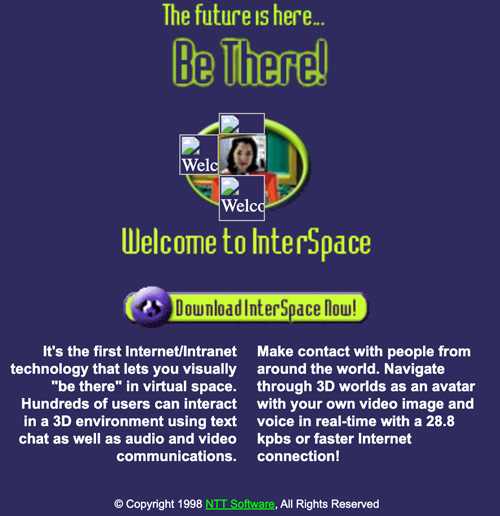
In the dawn of the internet’s evolution from static pages to immersive experiences, InterSpace stood as an early vision of virtual worlds — a pioneering experiment in real-time networked 3D environments developed under the auspices of telecommunications innovators in the late 1990s. By combining spatial navigation, avatars, and shared communication, InterSpace offered users a glimpse of what online interaction could become when transcending text chat and hyperlinks.
Participants entered a persistent virtual space where they could move freely, meet others, and engage in real-time conversations and activities — foreshadowing the social and collaborative universes that would follow in the decades to come. With support for interactive virtual presence, object scripting, user directories, and multimedia integration, InterSpace was a precursor to the metaverse — a formative chapter in the history of digital worlds that laid early groundwork for communal exploration beyond the physical plane.


InterSpace was an early 3D chat platform that experimented with avatar‑based communication and shared environments during the pre‑broadband era. It contributed to the evolution of graphical chatrooms and influenced UI conventions for early metaverse prototypes. Its emphasis on themed spaces foreshadowed the “world‑hopping” model later seen in VRChat and Rec Room. InterSpace helped normalize the idea of social presence in 3D environments.
Thank you for visiting the Virtual Worlds Museum
InterSpace
page! If you’re the platform owner and would like us to make updates to this page, please reach out to: info[at}virtualworlds.museum. If you’re a world builder who wants to help us create a museum hub on this platform, we’d be happy to hear from you as well. We welcome feedback and/or help and look forward to hearing from you.